Scientific Essay

Scientific Essay
Rodriguez Rey, Julio ⓘ
Universidad Nacional de Tucumán,
Centro de Investigación, Desarrollo e Innovación Industrial (CENIDII) ,
Av. Independencia 1800, San Miguel de Tucumán, Argentina
Camargo, Mauricio ⓘ
Lorraine University
Equipe de Recherche des Processus Innovatifs (ERPI)
8, rue Bastien Lepage, 54010 Nancy Cedex, France
Morel, Laure ⓘ
Lorraine University
Equipe de Recherche des Processus Innovatifs (ERPI)
8, rue Bastien Lepage, 54010 Nancy Cedex, France
It is hard to determine the causes of growth of the industrial SMEs. Even if different studies have shown that adequate firms management has strong relationship with growth, in the recent years, the importance of innovation in firms performance has been enlightened. Nevertheless, a lack of models defining these relationship mechanisms is found in literature. The classical approaches are divided into internal and external to the firm, losing the importance of the relationship between these two dimensions and firms growth. For the industrial firms, the Innovation management is still more important than in other type of firms. A conceptual model of Acceptance is proposed, partially based in classic management approaches, but adding an original relational dynamic. Acceptance in turn, is divided in six sub-criteria, highlighting the subjacent dynamics. The result is a model that includes the enterprise activities along with the environment behavior, showing this way the growth dynamic.
Growth in industrial SMEs may be the most important goal to the firms, and also to regional development. The impact of growth over job creation, technological development and value creation are vastly known. The main problem to encourage this growth is to know the root causes and the mechanisms that enable it. Furthermore, the SME management is more restrictive than big firm’s management. The lack of information systems and, more important, the lack in management skills, makes the understanding of growth dynamics even harder. SME managers do not always have enough time to generate and to analyze business information in order to take the right decisions. In most cases, they are all concerned about firm survival, making tactic decisions and thinking in the immediate cash flows. In other hand, SME activity develops over the short and mean terms, leaving the long term analysis to big enterprises. It is then necessary for SMEs to have an information model that can be feed with few and easily obtained information both internal and external, to know the actual situation while a growth strategy outline can be made.
In this article, a proposition of a conceptual model of the growth dynamics is presented. The model allows identifying qualitatively the interactions between its components and its impact on business growth. For this development there were considered classical approaches such as the Value Chain, the model PESTEL and other specific features that provide SME business. The company is modeled through its value-added processes in the form of activities. The environment is modeled by the relevant factors that generate the environment circumstances, in which the company operates. Finally, the matching between these activities and these factors are modeled by the concept of “Acceptance”, and its constitutive dimensions represented by six “facing instances” between firm´s activities and environmental circumstances. The Instances can be considered sub-criteria of Acceptance itself. Then, a conceptual model, that aim to infer the firm’s growth of this particular group, under certain circumstances is proposed.
Micro, small and medium-sized enterprises (SMEs) play a central role in the economy. They are a major source of entrepreneurial skills, innovation and employment (OECD, 2010). Frequently SMEs have difficulties in obtaining capital or credit, particularly in the early start-up phase, they are restricted to access to new technologies or innovation (Rosenbusch et al, 2011). Smaller firms differ from larger ones in their organizational structures, managerial skills, responses to the environment, and the way of compete. SMEs must overcome size disadvantages by creating advantages in flexibility of production, speed of action, niche strategies focusing on price and quality, and disrupting the status quo through innovation (Hughes, 2001).
Many of difficulties to convert R&D into effective innovation are organization specific. They cannot benefit of big volumes of production, economies of scale, etc. They should base their offer on the differentiation. Most of the SMEs run in an environment of informality (Milesi et al 2007). (Wincent, 2005) states that the SMEs face high degree of financial problems and the typical tools of strategic analysis are well adapted to it. The SMEs should think before in surviving rather than grow, so their focus is centered about the vulnerability factors. It seems that the better strategy for a SME is don't face openly to the competition, but rather look for a niche strategy. SMEs have a necessity of constantly contrast its strategic ambitions against its financial possibilities (Meunier, 2007). Smaller and especially new firms often lack this organizational capability and, thus, experience running the risk of engaging in managerial undertakings without experience. Reflecting on the perils of innovation, it needs to be noted that innovation is a hard task with high failure rates or at least temporary unprofitability (Roman and Atienza, 2005).
The OECD report (OECD, 2010), states that small manufacturing firms are almost as innovative as large firms. Additionally, SMEs also conduct a growing share of R&D. SMEs, however, are reported to face a number of barriers to their growth and survival including limited access to financing, limited market power, lack of management skills, high share of intangible assets, deficient accounting track and insufficient assets (O’Regan et al, 2006). The scenario of business in which operates an SME is conditioned by a group of factors, among those that stand out the regulatory frameworks, the rules and political macroeconomic, the industrial strategy and politics, the access to the markets, the degree of complexity of the productive network and the technological and organizational characteristics of the leaders companies in the sector
In the work of (Ian and Mangles, 1997), it is suggested that research on business growth can be classified into four main categories: entrepreneurial personality, organizational development, management skills and sector economy´s. Each of these areas of research provided useful information on the operation of small businesses. Nevertheless, limitations to provide an accurate model for predicting small business performance are perceived. Research on entrepreneurial personality tries to link the personal characteristics of the owner and manager with the performance of the company. Although different typologies have been developed to classify the employer, none of them has been convincingly correlated with firm performance. In conclusion, authors underline the need to consider other approaches to this particular problem.
In this sense, (O’Regan et al, 2006) indicate that under pressure to reverse a poor performance status, and with little chance of increasing efficiency in operations, it seems that small firms have not professionalized vision investing in R+D of new products as a realistic opportunity to progress. Arguably, however, this strategy may be riskier than other alternatives that allow for growth through other means. The results of the study support the idea that all SMEs have difficulties in converting R+D in effective innovation. The high-growth firms emphases the potential of existing products to meet the needs of current and future customers, improving the supply of proven products. High-growth firms are more oriented to sales. Results suggest that the external opening, industry positioning, strategic direction, and the e-commerce environment explain the high yield growth in industrial SMEs analyzed in this study.
From the point of view of resource-based growth, (Forcadell, 2004), illustrates the mechanism ensuring the existences of a dynamic and recursive relationship over time between resources and strategy. Thus, the portfolio of current corporate resources determines the future strategy and current strategy determines the future resource portfolio of the company. The relevant environment is constituted by the set of opportunities for investment and growth that entrepreneurs and managers perceive and that is different for each company and depends on your specific portfolio of resources (Lorentzen, 2006). Thus, the firm aims to leverage the portfolio of resources and capabilities and get them to adapt to the changes in the environment in the best conditions, in order to maximize value creation and sales.
Returning to studies (O’Regan et al, 2006), while recognizing the importance of the benefits that innovation presents to business growth, existing studies also warn that attach great importance to innovation as factors be the driving product development and creativity, along with other general field of management such as resource availability, volume reductions, cost and size of the company.
(Penrose, 1959) proposed that key determinants of the growth of the firm were internal processes that increased the capacity of production. Since the emphasis is on change within the firm. That is called endogenous growth theory. Firms consist of resources, and it is the growth and changing abilities of these that enables a firm to continually increase its productive capacity. From the theory of the strategic analysis, the firm’s mission, regardless of their size or activity, must be accepted by customers and others stakeholders. This Acceptance addresses different aspects in which the purchase of the product is the most obvious, but other aspects are added such as extended product, services, compliance and regulation, proper management of suppliers, and more broadly, the relationship between business, society and the environment. These aspects converge in the Acceptance of the company and its offering, achieving the objectives of the mission. This condition is in fact necessary for the growth of the company. From the earlier work in the discipline of marketing (Kotler and Levy, 1969) it is known that all organizations are concerned about the perception of their "product" to the eyes of consumers and try to find "tools" to promote their Acceptance. The authors named: The product itself, the service, the people, organizations and ideas. In the same paper, they warn about the acceptance in the sense that it must be referred to the following groups: Suppliers, Customers, Shareholders, active Public (government, institutions) and General Audience (Persons not associated directly). (Giget, 2000) indicates that there is a match between the activities of the company, the selected strategy and the new context, which results in the creation of wealth, while the customer perceives the value generated by the supply.
In recent decades, an important line of research focusing on user acceptance of new technologies has emerged (Davis, 1989). By understanding the major variables, models would be able to predict the actual use of a system, in order to adequately adapt services and new products to the market based on technology acceptance model (TAM). In the TAM model the author emphasizes in the relationship between Perceived usefulness, perceived ease of use, which together make up the attitude towards buying, is treated. This variables cause the buyer behavior, completing the acceptance process.
(Bauer et al, 2005) define a model for customer acceptance so that, among other components, is possible to enlist: Degree of innovation, perceived utility, existing product Knowledge, Information, Social Norms, access to information, entertainment, advertising Attitude social utility and perceived risk. In this case, the entertainment potential and the degree of information available were the most influential results in Acceptance.
In work (Pantano and Di Pietro, 2012) some factors used to measure the acceptance of a product or service can be found: costs, safety, standards, satisfaction, efficiency, behavior, social influences, trust and fun. From the consumer's standpoint, the expected benefits are: steady improvement, support consumers making purchasing decisions and improve the shopping experience. Therefore, it should not be a surprise that recently many efforts have been made in this regard, in order to increase acceptance
In the present model, “Acceptance” is taken as an indicator to infer the growth of the company. This approach has the background in definition of "Validation" by (Boly, 2008) that emphasizes the importance of client vision in the product/service design.
In works of (Chan and Mauborgne, 2005) a definition of a strategy to compete is outlined. This strategy is based on defining the characteristics aspects related to product / service, and the communication with the client, price, quality, etc. that are aimed to satisfy markets or unattended niches. The concept of "Value Innovation" is presented to refer to the creation of value for the client while that makes to the competition irrelevant. This way, value added is created for an unattended market, instead of fighting with the competition. This value innovation arrives when the companies are able to align product´s utility, price and costs. This concept challenges one of the most ingrained postulates about competition: The Cost/Value tradeoff. A decomposition of the strategy in useful parts for the taking of decisions is also presented. This way, an investment can be addressed to the implementation of a concrete strategy.
Strategy identifies a number of activities needed to grow, to counteract and overcome the constraints of the environment (Meunier, 2007). Companies, through its business and organizational process, must carry out these activities. The environment, through their factors, generates these restrictions by the casual (or not) confluence of different circumstances. For example, high inflation will make the customer's purchasing power falls. According to (Ferreira et al, 2015), firms with high innovation consider analyzing recent developments in technologies and markets to design strategic activities than firms with low innovation development.
(Giget, 2000) defines "contact points" as situations between the firm and the environment, actions that are "manageable" by the firm, in which the environment influences in some way. Of course, this list could be endless, but is limited to the same components of the Acceptance of product / service that the company offers as designing a growth strategy. That is, those features on which the company can influence the customer for approval for the purchase of the product, ie Acceptance.
The vast majority of models to analyze the firm’s growth contemplate the firm and the environment separately, leaving the interaction between these two worlds as a variable to conclude by the analyst. In some cases, like SWOT analysis, this interaction is enlighten, but once more, the interpretation of the event doesn´t tells the analyst what to do.
In the present proposition, a multi-dimension analysis is done acting over six important aspects where the firm and the environment meet and from there; converge in the Acceptance of the firm and its offer. Enterprises are constantly interacting with their environment. The company is exposed to the environment, for example, in the launch of a new product. It shows the product, generates an opinion, the product can be known, acquired, studied or even copied by the competition. Enterprises are also exposed to the environment through others “facing Instances” that it can defined as: Situations where environment are confronted with the actions of the firm. We can also say that these instances are sub-criteria’s of the main “Acceptance” criteria. To address a facing instance, the company must act specifically through its activities to overcome the forces of the environment. An example in the “Product” instance is the product of the competition as counterpart from the environment. The client compares both and draws its own conclusions.
The business environment is manifested in many ways. From the management sciences and economy, we can say that the environment is restrictive from the financial point of view, as the company has not usually needed freely available resources. Then, the first constraint is that resources have a defined value and that the company should make an effort to acquire it, expressed as the cost of these resources.
However, economic constraints are not the only ones. According to the sector in which to unfold, the company constrains may be technological, market related, legal, etc. Also, all companies have restrictions on absolute factors, such as the current level of human knowledge or physical constraints that simply humanity has not yet been able to overcome. From this extensive set of restrictions, the important ones are those that are directly related to the firm´s activity.
In this article a conceptual model of “Acceptance” is proposed. The main goal is to determine, via a relational dynamics, the most influents factors that impact in business growth. This concept in turn, is divided in others criteria, enabling a better understanding of the subjacent dynamics. To do that, performance dynamics must be considered and modeling the firm is necessary.
With this idea in mind, a literature review was done in search of the main components for the model and also looking for interaction descriptions between environment and firms, particularly with focus in business growth.
In recent years, literature has identified the increasing complexity of small and medium-sized enterprises (SMEs) and highlighted their sensitivity to differences in managerial culture and management systems. Research has shown that performance measurement systems (PMSs) could play an important role in supporting managerial development. Constrain for manufacturing SMEs are defined, e.g. lack of financial and human resources, wrong perception of the benefits of PMS implementation, short-term strategic planning, etc. PMSs should support SMEs to manage uncertainty, to innovate in their products and services, and to sustain evolution and change processes. PMS could support the decision-making processes in SMEs and help them improve their management processes and strategic control (Garengo et al, 2005).
Despite the recognized importance of performance measurement in SMEs, there are almost no models specifically aimed to SMEs. SMEs are characterized by poor strategic planning and their decision-making processes are not formalized. SMEs require approaches that respond to their specific needs and are efficient and easy to implement (Taticchi et al, 2008).
Alignment between strategy and performance measurement is particularly important in SMEs due the lack of formalized strategy, and implementing a PMS could promote the definition or formalization of business strategy. The approach to assessing stakeholder satisfaction in SMEs must be simple, including the following outlines:
Balance: between internal and external measures, in different organizational levels, related to the results–determinants relationship and (Kaplan and Norton, 1996) propose balancing four different perspectives based on the nature of the measures (financial and non-financial) and the object of the measures (internal and external). Balanced models can be defined as models that adopt different perspectives of analysis and manage them in a coordinated way.
Process oriented: Organizations should replace functional performance measures with process-related measures. Since SMEs are small, they have more visible end-to-end business processes, which make process orientation simpler.
Depth and Breadth: Depth is the level of detail to which performance measures and indicators are applied. The breadth of a PMS relates to the scope of the activities included in PMS. SMEs should use PMSs that focus on breadth, not depth. Causal relationship between results and determinants is strongly recommended
Clarity and Simplicity: to define and communicate objectives, measures (relative instead of absolute is recommended) and information presentation (Chennell et al, 2000).
According to the literature, SMEs need a simple PMS that can give the management focused, clear and useful information. The number of measures used should be limited. Most of the models analyzed are characterized by strategy alignment (Garengo et al, 2005).
There are multiple approaches for modeling enterprises and its dynamics. According to (Porter, 1985), a company can be modeled by its value chain. This approach emphasizes the value-adding activities and support activities. The main activities identified are: Internal Logistics, Operations, Outbound logistics, marketing and service. Then, the author identifies support activities: Procurement, Technology Development, Human Resources Management and enterprise infrastructure. These last support primary activities and also support each other, providing inputs, technology, etc. Moreover, (Salles, 2006) proposes a specific model for SMEs adding the role of innovation. Model includes the functions of: Production (human resources included), Economic and Marketing, Finances, the Innovation and Change as well as the Information function. (Giget, 2000) proposes six core functions: Two functions of resources (human and financial), and three functions of skills (design, production and marketing). Above all is the management function. Marketing function contains the management of the supply chain. There are also three cross-cutting functions: quality, communication (internal and external) and Innovation. More recently, (Silveira, 2013) presents a model for the electronic industry in Brazil, with three focus processes: Production in compliance with specifications, Manage company sustainability and continual innovation. The author also emphases the importance or marketing mix management to achieve better results in these processes.
However, models generally don’t include elements to clearly define the interactions between the company and the environment. For example, models based on the "balanced scorecard" (Kaplan and Norton, 1996) defines a number of interactions, mostly internal ones. Even though some models incorporate external elements, such as customer perspective, the dynamics of the interaction enterprise - environment results difficult to handle. Other models developed exclusively for SME like (Chennell et al, 2000) incorporate business success, the Community relationship, Customers, Key Players and People.
To model the innovation capability, among others (Assiélou et al., 2008) and (Corona, 2005) proposed innovation a model in their works, using surveys with 198 and 120 dichotomic yes/no questions to managers of the enterprises. These types of surveys have many disadvantages, due to the difficulty to answer large surveys and the redundancy of many questions. Considering this, it must be developed a tool that meets with the following characteristics, (a) A brief questionnaire to be answered by the interviewer, (b) clear definition of each parameter to be measured and (c) the use of verbal scales, defined for each evaluation. To make this, and following the development of (Camargo et al., 2007; Boly et al, 2014), the most important concepts are identified and measured, obtaining 18 concepts in six categories, without losing the capacity of analysis.
Table 1. Distribution of concepts into the six Categories. Source: Camargo et al (2007)
Categories |
Concepts |
| 1 Creation / Concept Generation |
1.1 Use of tools to increase the creativity |
| 1.2 Integration of the clients and suppliers in the conception process | |
| 1.3 Organization, compilation and management of information from the exterior | |
| 2 Conception Activities |
2.1 Use of tools of help to the conception |
| 2.2 Existence of a methodology of help to the conception | |
| 3 HR Management |
3.1 Management of competences and the skills of the society |
| 3.2 Innovation stimulation | |
| 4 Strategy |
4.1 Strategy integrated to favor the innovation |
| 4.2 Network operation | |
| 4.3 Client Importance | |
| 4.4 Financing | |
| 5 Project management |
5.1 Project administration |
| 5.2 Management of project briefcase | |
| 5.3 Organization of tasks tied to the Innovation | |
| 6 Capitalization of Ideas and Concepts | 6.1 Contnued Improvement of the innovation process |
| 6.2 Politics of Management of the intellectual property | |
| 6.3 Knowledge Capitalization |
Concerning to the analysis of the business environment, it is considered that the firm is influenced by many circumstances that interact with it. According to (Lehmann and Orteg, 2013) the business environment is a source of influences, pressures and constraints that impact business decisions. For (Forcadell, 2004) the relevant environment is constituted by the set of investment opportunities to growth that entrepreneurs and managers perceive and that is different for each company. According to (Milesi et al, 2007), the competitiveness level of the company depends on a wide variety of external sources that strongly influence on the activities that firms can adequately perform. Authors named among others: Customers, Suppliers, Competitors and, Government policies. In the work of (Robic, 2003) it is stated that the “fitting” model provides a suitable solution as it indicates that the resulting strategic behaviors of the adjustment to changes is functional to the competitive environment. The enterprise and the environment interact generating activities and constraints, provide a dynamic evolving that, in perfect balance, allows normal operation of the company, but does not allow growing. According to (Porter, 1985), competition continually works to reduce the rate of return on invested capital toward the competitive floor. Changes in the economic, financial, technological, social, political and legal represent a constraint but also an opportunity if they correspond to the practices, skills and history of the company (Robic, 2003).
In the work of (Trangdo, 2009) it is remarked that environmental factors often consist on the operation of financial markets, the development of the infrastructure and the presence of a legal, regulatory and institutional framework for implementation. In (Salles, 2006) it is stated that SMEs face an environment that is composed by Social factors of Customers, Opportunities of nature, Competitors, Suppliers, Market, Technology, The financial system, The regulatory framework and Local and regional policy among others. In (Porter, 1985), there are suggestions about some environmental analysis: Industry analysis and competition analysis, The five competitive forces includes analysis of substitutes, possible entrants, power of customers, power of suppliers, and rivalry among existing competitors.
In the work of (Chan and Mauborgne, 2005), authors note that Strategy can be defined based on an analysis of the current environment and their relationships with competitors (called oceans). On this basis, costs are defined functionally and converge in the concept of "Value Innovation". The effective implementation of this strategy will allow the company to overcome the threats of the environment or even convert presumed disadvantages to opportunities. The SWOT (Strength, Weaknesses, Opportunities and Threats) (Mintzberg et al, 1998) analyzes two perspectives (Internal-for Strengths and Weaknesses and External for Opportunities and Threats). The analysis considers identify two plans of improvement: Opportunities and potential problems. However, this analysis also provides a visibility about the company faced problems with the operating environment.
Stays that Strategy can be seen as a “Position” (Mintzberg, 2001) : A means of locating an organization in the "environment." Strategy becomes the mediating force between organization and environment, that is, between the internal and the external context. In management terms, it is a “product-market domain", the place in the environment where resources are concentrated. According to (Lehmann and Orteg, 2013), to grow 3 things are necessary: a well differentiated offer, operational profit, and sustainable position in the long run. In works of (Chennell et al, 2000) authors affirm that Success is not defined in absolute terms, but in terms of the added value that the company provides to stakeholders beyond the available in market. Therefore, these measures can be interpreted as success based in the "effort" of money, labor resources, etc. made by the company, compared with "effort" of alternative options. (Porter, 1997) states that the company must monitor the environment, especially the competition. Strategy involves commitments; limiting the company offer to a unique position value. Finally, special emphasis on the “fit” of the component of the strategy is made, thus preventing the easy emulation by competitors.
In this work, the interaction between enterprise and environment is proposed, based in the literature review, and having in mind a further quantification of the qualitative variables proposed here.
To achieve growth, the firms offer must be “Accepted” particularly by customers and most generally, for the society and stakeholders. This offer goes beyond the product and its price (Cost-benefit) and includes the information provided, the services associated, and the stakeholder’s dynamics and, finally, on the formalities that validates it.
Product / Service Acceptance is a key determinant of the enterprise growth, but it is not the only one. With the choice of others sub-criteria, it is pursued to effectively incorporate business management parameters so that, inferring the Acceptance by the model, is possible to ensure that the company is in growth condition. Other utility of this disaggregation is to include the influence of the different environmental circumstances in each of the sub-criteria of Acceptance, where converge situations generated by the enterprise and circumstances of environment (competition, government policies, customer requirements, etc.). These converging forces (from the enterprise and from the environment) generate in the sub-criteria a particular outcome in the acceptance by the customer.
As an example of the dynamics described, it is possible to imagine the existence of a new product and the market need that this product satisfy. In this case, in the sub-criteria Product / value a highly favorable outcome for the company is perceived. However, if product manufacturing generates heavy pollution, the sub-criteria of Society & Environment will have an unfavorable outcome, which can lead, in the judgment of customer value, to the rejection thereof. Similar dynamics can occur if the price is too high or if the information is inaccurate or insufficient.
If the environment is conceptualized as a conjunction of circumstances unchangeable by the company, the firm can only act on its owns activities influencing the sub-criteria of Acceptance. For example, in the case of pollutants, the firm should act on the corresponding instance so that the customer perceives the product as suitable for the environment. For this, the company must act on their internal processes, modeled by its activities. Through these activities, the firm works on the sub-criteria of acceptance counteracting the actions of the environment and thus tending to increase the acceptance of its bid by the market.
Not always environment generates constrains and restrictions. Sometimes, the environment acts favoring the strategy of the company. This is the case, for example, where a competitor has a very poor quality product. In this case, the proposed product will have a reference very easy to beat. By contrast, there are internal situations that work against the strategy of the company, as it is shown in Fig. 1. This is a case of the poor management skills. These internal constraints act against activities even before the activity could interact with the environment. While commonly opposition is assumed in the environment interactions (company trend toward increased acceptance and the environment acts against this trend), is common to find interactions that behave contrary (internal restrictions). Also, certain environmental circumstances (such as import prohibitions) can promote the Acceptance of the company´s offer, thus becoming facilitators
The sub-criteria or “facing instances” have important significance for SME companies. This concept was suggested in view of the deficiencies in Argentinian SMEs by (Milesi et al, 2007).
The purpose of this performance measurement system is to infer the growth potential based on variables that SMEs face daily. A series of activities that will shape the business model are defined from the perspective of process, meaning the same as sub-process of the overall business process, and the impact in sub-criteria of acceptance as a result of these processes.
A variable of overall success, as predictor of growth, is defined: the Acceptance. It determines customer compliance with the company offer in all its six dimensions. This concept, albeit with great conceptual strength, is vague in order to define its behavior in long term inferences. Acceptance can be measured in terms of business transactions (sales). Sales revenue is a more useful short-term goal for the firm than profit. Sales are measurable and can be used as a specific target to management. Specific sales targets are thought to be clearly understood by all within the firm (Jones, 2005).
As we know from the marketing discipline, the acceptance of a product is defined by a mix of parameters that the buyer takes into account when carrying out the acquisition. Among other features, (Kotler and Keller, 2006) indicates the intrinsic quality of the product, after sales service, the perception of the brand and the price, among others. Marketing mix tactics are defined as the set of controllable tools marketing tactics (product, price, place and promotion) that combines the company to produce the response you want from the target market, It is proposed that it is possible to extend this concept to a broader one, which, in addition to marketing, the concept considers the dynamics of the company and its relationship with the environment.
In this work, for business growth is meant growth in sales. On one hand it is directly measurable in SMEs and on the other hand, it is understood as the business premise and may be is the strongest because the other sources of growth such as market share, capital of technological collections, etc. are usually hard to measure. To achieve this growth, the model includes the Acceptance as a central component. This decision is founded on the model focus (the customer) and the Acceptance that it makes about the company's offer, materialized by the purchasing of the product / service that the company offers.
Strategy implies definition of a series of activities necessary to grow, to counteract and overcome the constraints of the environment. Company is responsible for carrying out these actions, which depend on the internal organization. In turn, the environment through its factors, determines the circumstances that generate these restrictions. For example, high inflation will cause falls of customers buying power.
Acceptance Model: A model that includes six sub-criteria is presented:
Management Model. Based in what is earlier described, a model for the enterprise is proposed:
Planning: (Lehmann and Orteg, 2013), (Giget, 2000), (Mintzberg et al, 1998). The planning includes all the activities that derive in an intellectual result in plan form, that is, activities, tasks, programs etc. The highest level of this activity is strategic planning, but also includes other planning’s activities like budgeting policies, sector analysis, etc.
Decision and control: (Salles, 2006) (Lehmann and Orteg, 2013) It is based on the planning and it is defined as the mechanism that allows to the organization fulfill that planned (Tactic level). It includes the tasks progress measuring, consumption of resources as well as taking the necessary decisions to maintain the planed direction.
Financial Management: (Salles, 2006) It includes payments, collections, general accounting, taxes, etc. It offers an essential service to the rest of the structure acquisition of the resources that the company needs to operate.
Technology management: (Trott, 2008) embraces all the aspects related with design of products, improvements of products and processes, support to the analysis of the technological and competitive environment, support to the planning, administration of the organizational learning, Information technology management, ERP systems etc.
Human Resources: (Porter, 1985) (Salles, 2006) this activity takes in charge the development of the person linked to the working and organizational capabilities (career management, general formation, remuneration, knowledge transfers in the company, management of successions, definition of the job, etc.)
Marketing: (Kotler and Keller, 2006) Marketing activities like market research, product specification, new market development, marketing mix decisions, etc. Marketing activities act strongly over the information emitted, like publicity and promotion. Marketing is defined as structural activity due the specific industrial profile of the model.
Internal Execution: (Robert et al, 2012) Activities linked to production (basics operations to add value from the production inputs to the final products or services) with emphasis in the efficiency. In industrial SMEs, the operations are maybe the most important activities due the majority of costs are incurred in this area.
Service: (Kotler and Keller, 2006) This activity includes to the operations that don't have as immediate purpose the product or main service, but the generation of the activities related to the enhanced product, (Warranty, after-sale, etc.)
Logistics and supply chain management: (Garcia et al, 2012) Activities of movement of materials and information from the far supplier to the final client. It includes the operations in themselves and the planning associated, maintains a narrow relationship with the activities of internal operation.
Administrative and formality management: (Saeed, 2009) (Yoguel and Moori-Koenig, 2000) It enclose all administrative task to compliant with current normative, development, implementation and execution of formal process to operate.
Stakeholders management: (Meunier, 2007) (Kotler and Keller, 2006) (or relationships management) to describe internal process that search, negotiates and executes actions to ensure a convenient and balanced relationships with the enterprise stakeholders.
Innovation Model. About innovation model, in this work is used the model proposed by (González et al, 2010) that works with the IIP (Corona et al, 2005) with a level of aggregation resulting in six categories of innovation practices. This model works over the Innovation potential instead the innovation performance. This way, the IIP model is particularly convenient to this approach that requires the knowledge of the present status of innovation management (and the other factor involved in the model) and not specifically about the results of innovation, that will take longer in evidence and this frequently render the model not suitable for SMEs.
Specifically, the model is conformed for 6 categories: Creation / Concept Generation, Conception Activities, HR Management, Strategy, Project management, and Capitalization of Ideas & Concepts. This model is chosen considering its suitability to SMEs analysis and also it allows a comprehensive understanding of the innovation phenomena in a management level.
In the literature there is a special emphasis on the business environment. Modeling the environment is not easy, since there are not two similar environments and the environment is not the same over time. While the company operates voluntarily to drive the interaction between firm and environment getting better results as possible, generally the environment does not. Due to the different nature of their components, we can speak of a 'will' of the firm but we can´t speak of the "Will" of the environment. The behavior is more chaotic in the environment and frequently reacts in response to modification. We can then speak of the "circumstances" of the environment instead of its "Will". However, usually in business modeling, the dynamic between the company and the environment is not discussed in the sense of the mechanisms to anticipate or infer business growth, despite being a major factor in literature.
In this work, to model the environment, a conceptual base was taken from the PESTEL model, proposed in (Lehmann and Orteg, 2013), which includes the following factors: Political (Intervention in the economy, subsidized activities, education, international polices, etc.); Economic (Interest rates, economic growth, inflation, etc.); Social (aging, culture, organic food trends, etc.); Technology (Universities, knowledge management, TICs, R&D intensity, etc.); Environmental (climate change, desire to protect the environment, pollution laws, etc.); Legal and regulatory (Discrimination legislation, Major requirements for companies to recycle, Consumer and competition law, labor law, health and safety legislation , etc. and other regulatory factors (such as ISO, etc.) that may be required to the firm to operate).
In addition, in the model was added the following environmental factors:
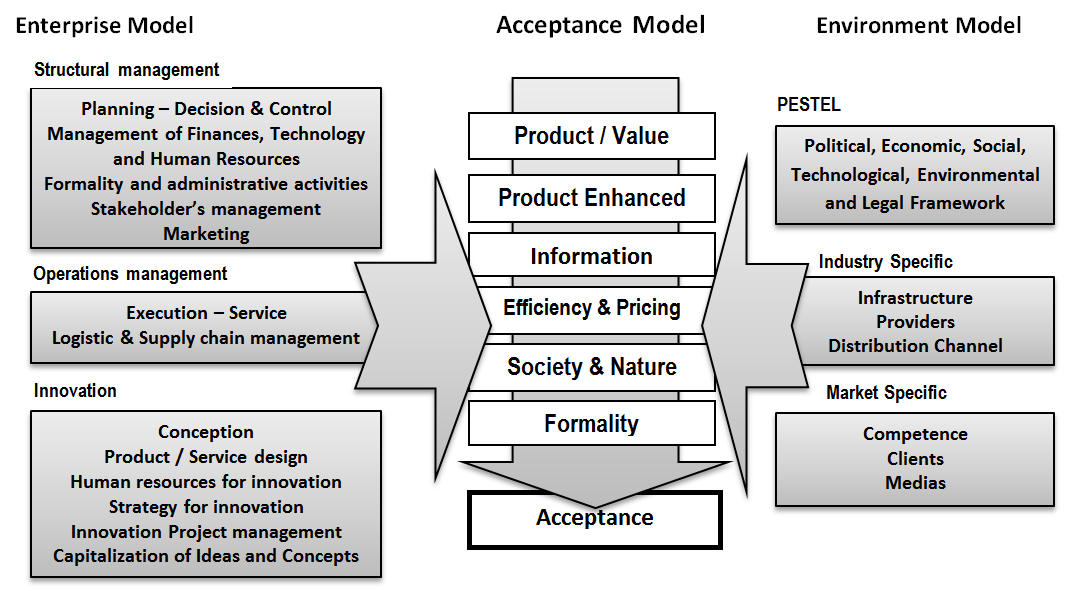
In this work a qualitative relational model composed by three sub-models: Enterprise, relational framework and environment are presented. The innovation of this model lies in the use of the guiding concept of Acceptance, objectified and specified by sub-Acceptance criteria, signified by the facing instances between the company and its environment. This way, Strategy can be seen as a definition of states of these sub-criteria of Acceptance in client perception, allowing managers to easily evaluate and outline a competitive strategy with punctual information generally available in SMEs.
A particular emphasis is made in the interaction among the enterprise and the environment. These characteristics have an important conceptual value considering the lack of the literature, especially for SMEs. The relational dynamics between these two entities are frequently remarked, but it is not generally described with the necessary precision that allows decision making in SMEs. The split of the main Acceptance concept in more significant variables enhances problems visualization. It is expected that the operation of these sub-criteria results in a significant wealth of analysis for managers and researchers.
Innovation management is considered along with traditional management. This last is due the close relationship between these two concepts that are commonly studied separately and even unrelated. This conjunction allows studying more “real” SMEs where these two groups of activities are very closely related but operates frequently in two different temporal horizons. It is vastly known that innovation has beneficial effects in firm’s performance, but it is also known that there must be some pre-existent management conditions that enable the mechanisms that allow innovation acts. Performing the separation of management activities in three groups (structural, operational and innovation management), it is awaited a more detailed set of relationships between these concepts and growth.
The main expected results of the application of this model is its validation of Acceptance as a predictor of enterprise growth, determining business practices related with growth and the possibility of analyze alternative scenarios.
Model has been conceptualized according with the industrial SMEs current management, having in mind the limitation of these particular groups of firms. The Performance measurement Systems (PMSs) have in this model an opportunity to enrich the set of variables in comparison with big enterprises systems that are not realistic in order to apply in SMEs.
In further works would be desirable to obtain a quantification methodology that supports the model and allows computing the variables involved. In this sense, the interaction between variables must be considered in the quantification and possibly, the definition of indexes could be necessary.
As all multicriteria models, the determination of weights for the model is an important problem. Correct parameterization of this last will help to create scenarios and evaluate different strategies in terms of growth impact.
Assielou, G. (2008). METROLOGIE DES PROCESSUS D’INNOVATION - These doctoral. Nancy: INPL. 🔍
Giget, M. (2000). La dynamique stratégique de l’entreprise. Paris: Dunod. 🔍
Jones, T. (2005). Business economics and managerial decision making. Wiley. 🔍
Kotler, P.; Keller, K. L. (2006). Marketing Management. New Jersey: Pearson. 🔍
Kotler, P.; Levy, S. (1969). Broadening the Concept of Marketing. Journal of marketing, 10-15. 🔍
Meunier, A. (2007). PME: Les stretegiés de succes. Paris: Dunod. 🔍
Mintzberg, H. (2001). The Strategy Concept I - Five Ps For Strategy. 🔍
Porter, M. (1985). Competitive advantage. Free Press. 🔍
Porter, M. (1997). ¿Qué es Estrategia? Revista INCAE, Vol. X, N°1, pp 35-52. 🔍
Salles, M. (2006). Stratégies des PME el intelligence économique. ECONOMICA. 🔍
Article
Innovation, management and growth in industrial SMEs: an Acceptance Based Model
Publisher:
Journal: Técnica Administrativa
Volume: 25 , Number: 1, Order: 5 ; ISSUE: 105
Date of publisher: 2026-01-15
URL: www.cyta.com.ar/ta/article.php?id=250105
License: Atribución 4.0 - Internacional (CC BY 4.0)
© Ciencia y Técnica Administrativa
Registro ISSN: 1666-1680
Primera instancia: Curación académica realizada por CyTA, según criterios de integridad científica, semántica y estructura académica (disponible a partir de 2024/07).
Segunda instancia: Curación asistida por inteligencia artificial (ChatGPT, desarrollada por OpenAI), mediante prompts especializados diseñados por CyTA (disponible a partir de 2001/09).
Este protocolo implementa un modelo de revisión abierta, responsable y trazable, centrado en la formación, la transparencia y la accesibilidad del conocimiento.
🎓 Academic Review contributed by: »
✨ Curation Assistant, GenAI contributed by: ChatGPT, Copilot, Gemini, Et al. »
Triples of the Data Model Semantic RDF »
To send article, send it to the email: editorialcyta@gmail.com or cyta@cyta.ar
Identify it, in the subject field, with the word: Article
In the body of the email, indicate the following information for each of the authors, name to be quoted, filiation, and email.
Técnica Administrativa se encuentra indexada en los siguientes directorios de publicaciones científicas: Scholar Google, DIALNET, ZDB, LATINDEX, WorldCat, Crossref, REBIUN, PURL, Ágora, Miar, BINPAR, entre otros.